The Source
Beautiful writing about delicious British food. Articles, comments and musings from our contributors.
Tony Mulgrew sits on the Love British Food Schools Working Group. Here he shares his experiences of sourcing quality British food for his school menus.
About the school
Ravenscliffe High School is a Special Education Needs school for 11 – 19 yr olds spread over 2 sites.
223 students across two sites: 156 on one site; 67 on the other site.
It caters for students with all aspects of autism and learning difficulties. As a result they can be very vocal in telling Tony what they think of the food; which is great!
The school is highly respected in the community as it is the only one to provide for special needs. The local community contributed ½ million towards £3 million build the new site, a sign of how highly respected the school is.
The whole concept was to serve to the public with the students helping to be front of house and back of house giving them life skills which would help towards full time employment when the school café open to the public. Wanted to use all local produce. It has been a fantastic success but Covid-19 has put a stop to the community café side of things.
Catering facilities
When Tony became Chef Catering Manager in 2012, the school had one gas range and two old fashioned school ovens and an old fashioned steamer.
Over the 10 years Tony has been Chef/Catering Manager, they have rebuilt the kitchen with top of the range ovens, all stainless steel surfaces and equipment. As Tony says: “This is essential as without a fully equipped modern kitchen you are restricted by what you can achieve.”
In the original site, there are 2 sittings in the main dining room plus a couple of classrooms are also used for lunch.
In the new purpose built site, there is a brand new a community café serving both students and the public that sits 74 people.
The new facilities were funded with a huge fundraising initiative led by the Head Teacher who encouraged the whole school and community to get behind his vision. There were fundraisers, farmer stalls, special schools days over a 5 year period to raise the money. The public could buy a brick in the walls of the new building. Local businesses supported and they applied for funding via many channels. As a result they raised £3.2 million.
What was the catalyst for sourcing locally?
Tony grew up in Northern Ireland where there is very good local produce everywhere. Northern Ireland does local produce really well. As Tony says: “Having grown up in that environment it was important I used local produce. In the 70s growing up there, everything was fresh. When I went into catering in 2001, it was very important that we provide fresh produce in schools.”
Before Tony was appointed at Ravenscliffe in 2012, the catering was under the Local Authority. The school had taken the decision to move the catering in house and so they hired Tony. The day that Tony started work there was a delivery of frozen chicken that was bulked out with (TVP) textured vegetable protein in with the chicken. This was an anathema to Tony so he immediately got on the phone and ordered fresh chicken breasts.
What is the farming and producer hinterland around the school?
Ravenscliffe is on the outskirts of the town centre so there are no farms close by. The closest is the farmer who supplies free range eggs 4 miles away.
But, half a mile away there is a high street butcher who now supplies all the school meat. He holds a cutting license so he can source from around the country and cut the carcasses. He also supplies the school its fruit and veg and its dairy. It is all British. For example, the milk comes from Grassington in North Yorkshire, potatoes from Spalding in Lincolnshire.
This butcher supplies 84 schools out of 109 in the Calderdale area. All his meat is certified Red Tractor and fully traceable. He gets audited at least twice a year.
Budget
£1.20 food costs per pupil per lunch. (most schools get approx. 85p per pupil).
How has Tony got a bigger budget? Very simply, he asked the Bursar saying “If you want quality, you need to pay for it.”
Tony prices his lunch out as follows (using fish as an example):
1 piece of fish 78p, breading it 80p, then veg x 3 at 13p per portion. So minimum £1.19p. Then desert needs to be done. So you can see even with a good budget it can be very hard to produce and this is why chefs/cooks need the flexibility to change menus and buy local and seasonal.
He tells the butcher: “This is what I can afford. Can you supply me British within this?”
Sometimes the butcher will say to him: “I have x amount of meat, can you take it?”, so it is a partnership relationship with his supplier.
A good example of how this relationship with suppliers works to both the supplier and the school benefit is the case of one of their organic cheese producers. They produce beautiful organic cheese but very few restaurants can afford to buy it because restaurants do not want a low shelf life whereas schools operate on a 5 day week so they can take it.
Menus
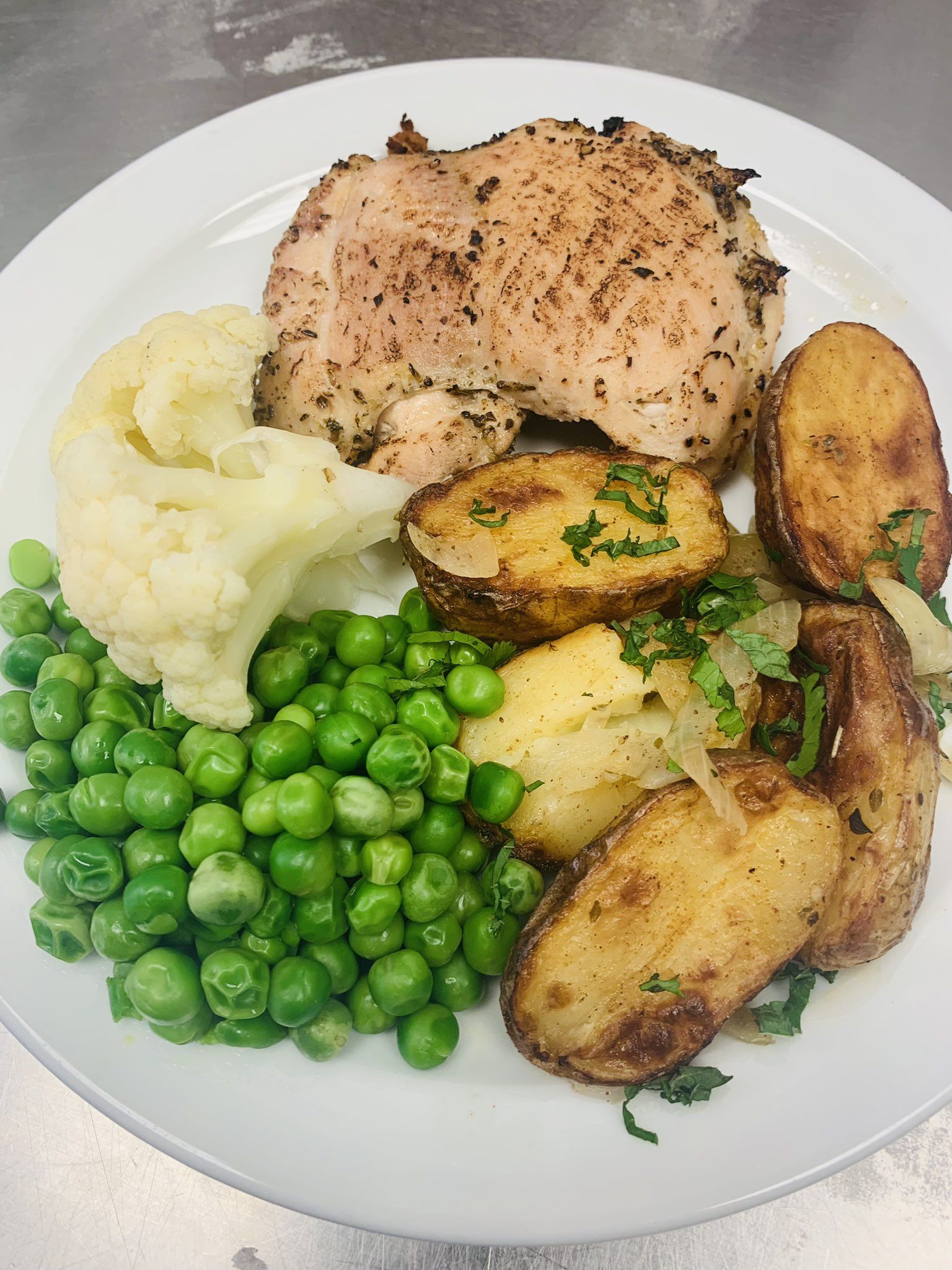
Tony always serves 2 veg.
He doesn’t use a dietician or nutritionist.
He uses common sense. For example, he doesn’t serve potatoes if meat and potato pie is on the menu.
It is about balance and flexibility.
Lessons learnt and Top Tips
- Speaking to local suppliers is key: Be up front, be honest. Tell them what you want and ask them if they can help you with it. e.g. “This is what we have to work with, can you offer us something within that?”
- Remember that schools have bargaining power as schools are a robust customer. They will pay straight away and a supplier is guaranteed that the business will not go bankrupt or go bust, as may be the case with a restaurant.
- Schools must have flexibility to change menus to adapting to what is in season. Not everything is in season all the time! And not all clients/students eat the same across the country. As Tony says: “This is essential if we want to be sustainable and conscious of our carbon footprint. We need to train cooks and caterers about seasonality, not just fruit and veg but meat and fish too. Some meats are much cheaper at different times of year. Speak to your butcher. He knows the market, the prices, what is available.”
- Engage the Bursar and Head Teacher. The budget available is key.
- Consider not serving a sugary pudding to put more money into the main course. You don’t have to serve a pudding!
Where can other catering managers get advice and support?
It is very hard. We should all be sharing and supporting each other.
The new Love British Food Schools Working Group hub will help.
School Food Plan website that has been set up by School Food Standards: http://whatworkswell.schoolfoodplan.com/articles/category/52/recipes-menus: you can download recipes free of charge. All recipes should be free of charge. Various chefs across the country have contributed recipes.
https://www.ukfoodplan.org/ has a good database of vegetarian and vegan based recipes for schools. It is funded by The Vegetarian Society. You can put in your email address and name of school and you can download recipes for free.
A final word from Tony
“I get a kick out of a student coming to the hot plate and saying ‘Tony, that sauce was damn hot!’ or ‘I really enjoyed lunch today’. There is nothing better than a thank you from a student.”
“Schools are a brilliant, robust customer for farmers, growers and producers. It doesn’t make sense why a farmer would not work with a local school, hospital or nursing home. We need to get this message out!”
“There are some fantastic contract caterers and consortiums out there. But I would always advise schools to look at the benefits of having control of their own food. Yes you have to invest to start with but the health and wellbeing of students long term pays it off.”
Interview with Tony on SoundCloud:
Share:
You may also be interested in...